
The Wiper Blade Problem We Finally Solved, and I think you should know about.
1/30/20264 min read
A decade ago, wiper blade failure was predictable. Almost seasonal.
Winter would arrive, and service centres would fill with complaints: chattering blades, streaking, that horrible squeaking noise. Summer brought a different set of issues—smearing, rapid wear, blades that seemed to disintegrate after a few months in the sun.
We accepted it as normal. "That's just how wiper blades are," technicians would say. Customers replaced them every six months and assumed that was the cost of clear visibility.
But here's what isn't widely discussed: that problem no longer exists. We solved it.
The Physics Problem That Used to Define the Industry
Traditional wiper rubber was viscoelastic—its mechanical behaviour changed dramatically with temperature. This wasn't a manufacturing defect or a quality control issue. It was fundamental materials science creating an impossible situation.
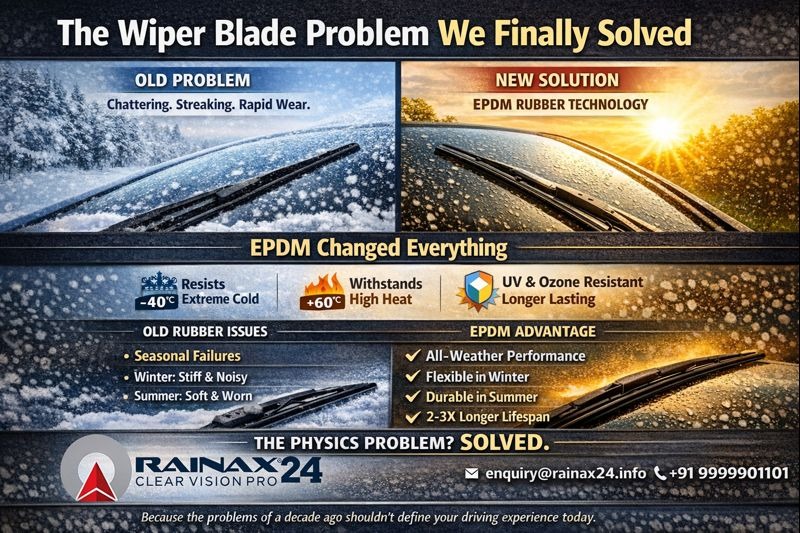
In cold weather, conventional rubber would approach its glass transition temperature. The molecular chains would lose mobility. The blade would stiffen, losing the conformability it needed to maintain contact with every contour of the windshield. Result: chatter, skipping, noise.
In heat, the opposite happened. Summer windshields regularly exceed 60°C in direct sunlight. The rubber would soften, edge stability would collapse, and UV radiation combined with ozone would accelerate oxidation, breaking down the polymer chains. Result: smearing, rapid wear, shortened service life.
The industry's response was to position this as inevitable. Sell seasonal replacement. Market "all-weather" blades that were really just mediocre compromises. Keep customers on a replacement treadmill.
For decades, that's exactly what we did.
The Material Science Revolution Nobody Celebrated
Then EPDM rubber (Ethylene Propylene Diene Monomer) changed everything.
EPDM exhibits exceptional thermal stability across the entire temperature range wiper blades encounter—from -40°C to beyond +60°C. It maintains consistent mechanical properties in both extreme cold and extreme heat. It doesn't stiffen in winter. It doesn't soften and degrade in summer.
The breakthrough wasn't just temperature stability. EPDM brought:
Superior UV resistance — the polymer structure remains stable under prolonged solar exposure
Exceptional ozone resistance — oxidation degradation is virtually eliminated
True weather independence — performance remains consistent regardless of climate or season
Genuinely extended service life — 2-3x longer than the old rubber compounds
This wasn't an incremental improvement. It was a complete solution to the physics problem that had defined wiper blade limitations for half a century.
So Why Do People Still Think Wipers "Just Fail"?
Because the industry hasn't told them the problem was solved.
At Rainax Motors, we started manufacturing with high-grade EPDM rubber as standard over 10 years ago. Not as a premium option. Not as a marketing upgrade. As the baseline for what a wiper blade should be.
The results were immediate:
Customer complaints about seasonal performance drops disappeared
Replacement cycles extended from 6 months to 18-24 months
The chatter, squeaking, and smearing that drivers had accepted as "normal" simply stopped happening
The physics problem that plagued the industry for decades? Solved.
What Modern Wiper Blades Actually Deliver
When you use genuine EPDM rubber—not blended with cheaper compounds, not thinned out for cost savings—wiper performance stops being weather-dependent:
In winter, blades remain flexible and comfortable even in sub-zero temperatures. No stiffening. No loss of windshield contact. No chatter or noise.
In summer, blades maintain their edge stability despite high heat. UV exposure doesn't degrade the material. The blade doesn't wear down after a few months of sun exposure.
Year-round, drivers get consistent, reliable performance without thinking about their wipers—which is exactly how it should be.
The Industry Secret
Here's what many manufacturers won't tell you: the technology to build wiper blades that genuinely last—that perform consistently across all weather conditions—has existed for nearly a decade.
The challenge was never technical. It was economic.
EPDM costs more than conventional rubber compounds. Blades that last years generate less replacement revenue than blades that fail every 6 months. The business model had optimized for failure, not performance.
But that model only works if customers don't know there's an alternative.
Why We're Saying This Now
At Rainax Motors, we've spent the last several years proving that the old excuses don't hold. Temperature isn't a limitation anymore. Weather isn't a valid reason for blade failure. UV degradation isn't inevitable.
The materials science caught up to the engineering challenge. What hasn't caught up is the industry conversation.
Drivers still expect their wipers to fail every few months because that's what happened a decade ago. They still accept squeaking and chattering as "normal" because nobody told them the problem was solved. They still replace blades seasonally because service advisors recommend it out of habit, not necessity.
It's time to change that conversation.
What Quality Actually Means Now
When someone asks why their wipers failed after four months, the answer shouldn't be "that's just how they are." It should be "you're using the wrong materials."
High-grade EPDM rubber doesn't have the thermal limitations of old compounds. It doesn't degrade in UV exposure. It doesn't require seasonal optimisation or temperature-specific formulations.
It just works. In February. In August. In Delhi. In Shimla.
The decade-old problem isn't a problem anymore—unless you're still using decade-old technology.
The Bottom Line
Wiper blade failure used to be a physics problem. Soft compounds worked in cold weather but failed in heat. Hard compounds lasted in summer but became useless in winter. There was no single material that could handle both extremes.
Then EPDM solved it. Completely. Years ago.
The only question now is whether customers know they don't have to accept the old limitations anymore—and whether manufacturers are honest enough to tell them.
At Rainax Motors, we believe quality isn't about marketing claims. It's about using materials that actually solve the problems customers face.
The wiper blade problem? We conquered it. The awareness problem? That's what we're working on now.
When was the last time you thought about your wiper blades? If the answer is "never," that's exactly how it should be.
Rainax Motors Private Limited — Manufacturing wiper blades with advanced EPDM rubber technology. Because the problems of a decade ago shouldn't define your driving experience today.
Contact
Get in touch with us today.
enquiry@rainax24.info
+91 9310033339
Home
>
>
>
>
>
>
Quick Links
+91 9999901101
>